 |
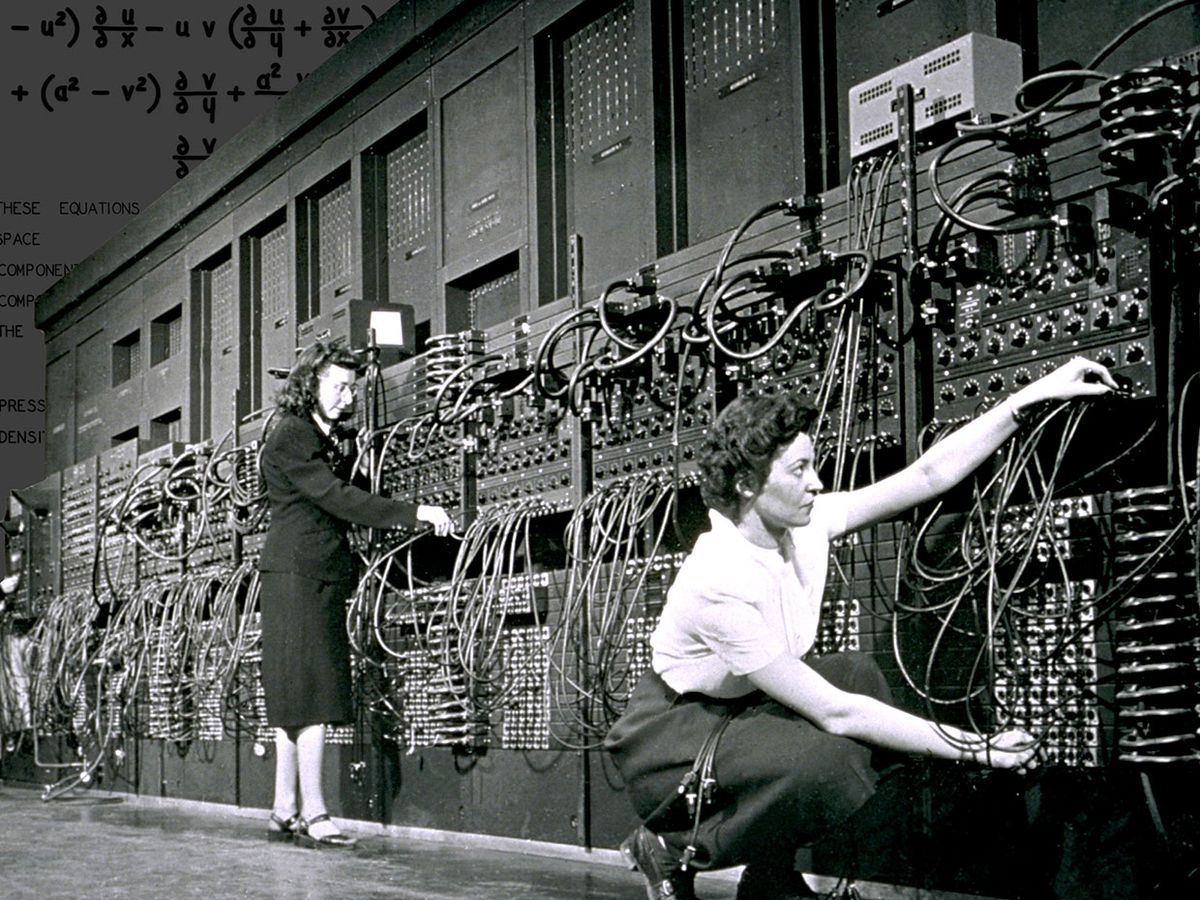
| Marlyn Wescoff and Ruth Lichterman Programming ENIVAC |
Although I lived through early stages of the digital age with avid enthusiasts in my family and on the job using a main frame, I was fascinated by Walter Isaacson's book The Innovators.
I learned many surprising things when I read Isaacson's book. In
it he traces the development of the digital age from its inception
until the year 2014 when the book was published. It all started with a
desire for making difficult calculations simpler and less time
consuming. Mechanical devices offered some success but many small
advances were required before the first electronic computer could be built. In the mid 1930's using vacuum tubes as on/off
switches in electronic circuits sped up processing which had relied on
electromechanical switches. The advances in computing in the 1930's
"came from a combination of capabilities, ideas, and needs that
coincided in multiple places," as Isaacson states.
The military became involved because of the need to make tedious calculations for trajectories for guns after the entry of the United States into World War II in December 1941. In 1943 The U. S. War department decided to fund an electronic computer and the construction of the ENIVAC soon began. Although the Defense Department financed much of the development of early computers and of the internet, the academics and researchers who were were directly involved making technical decisions and doing the work, designed a system for collaboration and research. On page 251 we read, "'Janet Abbate noted ... the group that designed and built ARPA's networks was dominated by academic scientists, who incorporated their own values of collegiality, decentralization of authority, and open exchange of information into the system.' These academic researchers of the late 1960's, many of whom associated with the antiwar counterculture, created a system that resisted centralized command. It would route around any damage from a nuclear attack but also around any attempt to impose control."
A system using personal computers for working alone, along with connectability to a web of other users, took many more steps before individuals had access to data and the ability to interact with one another through electronic devices. The system developed out of the effort of many thinkers and engineers and innovators working together or working in isolation or in groups to invent specific procedures which could be fitted together. It involved a collaborative process which led to unexpected creativity. It depended upon academics, government, businesses and solitary inventors. Computers and networking are built on the work of predecessors who had no inkling of what could follow their innovations.
Although we have been given a toolbox which opens vast possibilities, each of us has a responsibility for using it wisely and circumspectly.
If this post reminds you of your experience with computers please make a comment below. We would be pleased to hear about your initiation, your discoveries, your frustrations, your satisfactions and your hopes.
Posted by Ellie


This post caused me to think about where we are going with all this technological advances, how we can use it for good and also how many may end up using it for destruction. I remember seeing a Painting in a school textbook when i was in Junior highschool. it was a depiction of machines sorta like robots causing destruction and doom to the world. This was before i ever had a computer, before cell phones were invented, and it makes me think. Now that i am much more mature and we seem to be stepping into a new age of technological improvement, i can see how the fear surrounding smart machines or robots may be a tool of destruction. The BIG question is, in what way may technology be harmful, or is it the mind that created it with harmful intent? these are quesions that i ask myself. thanks for the post by the way. be peace, be light
ReplyDeleteEvery group from the smallest to the largest depends on the characteristics of the members. The users of computers will determine if computers are used for good or ill. If enough individual humans have the wisdom and integrity to use computers for the benefit of the whole of our planet and its occupants, there is hope that we can build a world that is more equitable, just and sustainable.
ReplyDeleteChange comes from the actions of individuals through the creative use of the available tools.
would you say most people are good or ill?
Delete"Change comes from the actions of individuals through the creative use of the available tools" - true, as far as it goes; but these tools have been devised in such a way that even good, creative, productive use has its downside, in adding to the data being amassed about everyone online, in reinforcing our tendencies to interact online rather than in person, in making us dependent on the tools themselves rather than honing our skills independent of the tech infrastructure. Not to mention the money people spend on the devices and services... and the ecological impacts....
Deletehttps://thereader.mitpress.mit.edu/the-staggering-ecological-impacts-of-computation-and-the-cloud/
By James Russell Lowell
ReplyDelete1 Once to every man and nation
Comes the moment to decide,
In the strife of truth with falsehood,
For the good or evil side;
Some great cause, God's new Messiah,
Offering each the bloom or blight,
And the choice goes by forever
Twixt that darkness and that light.
2 Then to side with truth is noble,
When we share her wretched crust,
Ere her cause bring fame and profit,
And 'tis prosperous to be just;
Then it is the brave man chooses
While the coward stands aside,
Till the multitude make virtue
Of the faith they had denied.
3 By the light of burning martyrs,
Christ, Thy bleeding feet we track,
Toiling up new Calvaries ever
With the cross that turns not back;
New occasions teach new duties,
Time makes ancient good uncouth;
They must upward still and onward,
Who would keep abreast of truth.
4 Though the cause of evil prosper,
Yet 'tis truth alone is strong;
Though her portion be the scaffold,
And upon the throne be wrong:
Yet that scaffold sways the future,
And, behind the dim unknown,
Standeth God within the shadow
Keeping watch above His own.
Thanks, Ellie, for encouraging me to read this book. It brought back many memories of my own experiences with computers, starting in aboout 1971 when a young acquaintance was eagerly explaining to some friends how much fun, and how easy and logical, computer programming was. He had a printout of his program and he walked me through the steps of how it worked. He was right: it was fun, easy and logical, and led me to quite a few jobs and hobby projects through the 70s, 80s and 90s.
ReplyDeleteSo many of the names and events in the book were at least vaguely familiar, and it was interesting getting more detail. But what I really liked was the food for thought, around collaboration and intentionality, the early attempts to solve particular problems, and the later inspiration as to giving people something they might really like and enjoy. Nowadays the latter seems to have morphed into trying to devise new ways to hook people on carrying their devices everywhere and hooking them more and more securely on spending time with their "screens" rather than face-to-face encounters with other humans and the rest of so-called reality.
Of course computers and the internet can be seen as mere "tools" for ordinary people to pursue our individual goals and interests. But they've also become tools for the concentration of power, surveillance, and control. Most of us seem to be all too ready to go along and be used....